




Setting Sail: The Journey
of Life
Life is like a boat journey across open waters.
We get used to the sunny days, the storms, the cold spells, and the moments of calm… just like the ups and downs of everyday life.
And we keep moving forward, living through it all… until something unexpected happens.




Hitting a Rock: A Serious Illness
What is palliative care?
Palliative care is specialized medical care that helps people with serious illnesses
and their families live as comfortably and fully as possible. It focuses on improving
quality of life by understanding and supporting physical, emotional, social, cultural,
and spiritual needs. Because every person is unique, the type of support provided is
tailored to what each individual needs most.
Who is palliative care for?
Palliative care is for anyone… babies, children, adolescents, adults, and older
people who is living with a serious illness, at any stage. It also supports caregivers
and families who are affected by that illness.
Whether it’s cancer, stroke, lung disease, dementia, multiple sclerosis, cerebral
palsy, Parkinson’s, or any other condition that affects your physical, emotional,
social, or spiritual well-being, palliative care is here to help.
Palliative care is care for a person that goes beyond their disease, and looks after
their family too.
Hitting a Rock: A Serious Illness
When should I start palliative care? Why?
When a serious illness is diagnosed, the doctor outlines treatment options. What
follows are multiple tests, second opinions, decisions, and the start of treatment.
This period is often confusing, uncertain, and stressful—where the focus shifts to the
illness, and the person and their family can get lost in the process.
This is why palliative care is important from the moment of diagnosis. It focuses on
the person and family, their comfort, dignity, and support, recognising that serious
illness affects not just the body, but every aspect of life—for patients and those who
care for them.
Palliative care is appropriate at any age and at any stage of serious illness, and can
be provided alongside curative treatment. While it is often associated with end-oflife care, palliative care is most effective when it begins early—right from diagnosis.




Meet the Lifeboat Crew: Your Palliative Care Team
Who provides palliative care?
Care is provided by a specially trained team of doctors, nurses, and other
professionals who work alongside the patient’s treating doctor to offer an extra
layer of support. This multi-disciplinary team includes a doctor, nurse,
physiotherapist, nutritionist, counsellor, social worker, and volunteer who come
together to address all your needs and the needs of your family through a holistic
approach.




The Rope of Support
How do I know palliative care is right for me?
Palliative care may be right for you (or your family) if you have a serious illness such
as Cancer; Congestive heart failure (CHF); Chronic obstructive pulmonary disease
(COPD), emphysema, lung disease; Kidney failure; Liver failure; Neurological
diseases (e.g., ALS, Parkinson's) or Dementia. Additionally as a result of the illness if
you have symptoms that make it difficult to be as active as you would like to be (Eg
pain, shortness of breath, fatigue, anxiety etc), then you should ask your treating
doctor about palliative care services. The palliative care team can also help you or
someone close to you - knowing what to expect and what resources are available as
well as providing support to patients and caregivers on coping strategies to
manage the stress of a serious illness
How do I pay for palliative care?
At the Cipla Palliative Care and Training Centre, Pune all services are free of cost to
the patient and caregiver whilst providing the highest level of quality of care. In
other centres and cities, please do check with the palliative care providers about
financial support (if any).

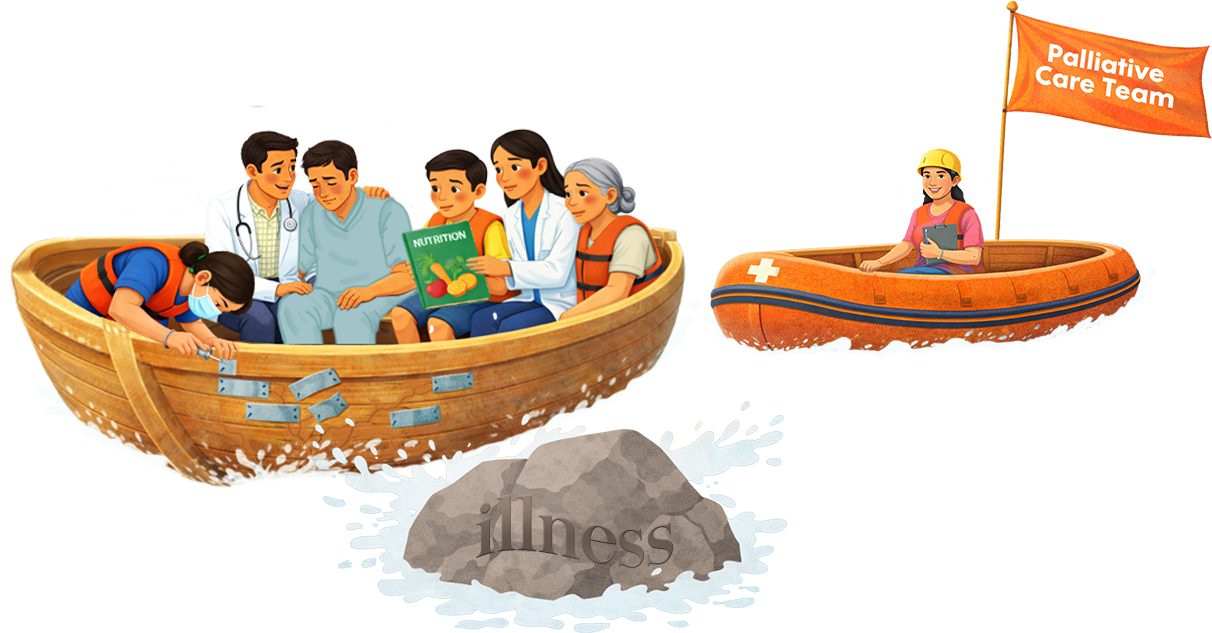

Repairing the Boat: Managing Symptoms
What can I expect from palliative care and why do I need it?
Palliative care can help provide relief from pain, assist in managing symptoms,
lessen anxiety and worries about the treatment, enhancing the quality of life of a
person and family living with a serious illness, and answering all the questions you
have when going through a difficult time.
Helping Navigate the Waters: Emotional & Social Support
Even as the care team steps in closely, ongoing support remains available — ready to assist whenever new needs arise throughout the journey.








Helping Navigate
the Waters: Emotional & Social Support
Palliative care puts the person and family at the centre of care. How?
It takes a person-centred approach—treating you the way you want to be treated,
listening to your needs, preferences, and values, and involving you and your family
in planning your care. Because everyone is different, the support is tailored to each
person.
Palliative care can improve your quality of life and also support your carers and
family. It helps you navigate the physical, emotional, and practical changes of a
serious illness, offering space to talk through sensitive issues and plan for the future.
The team helps you live as fully as possible, while also connecting you to services
that can support your daily, emotional, and financial needs.
Support Anywhere You Are
The palliative care team continues to guide and support patients and their families through OPD, IPD and/or Homecare services and through our national palliative care helpline - Saath-Saath. They point the way ahead, ensuring the family never feels lost on their journey.
Where can I access palliative care?
As early as possible, as soon as you or your family member is diagnosed with a serious illness. You could get Palliative Care in a hospital, at your home, at an outpatient clinic or by calling on your palliative care helpline Saath-Saath 1800-202- 7777.


What the Lifeboat Represents
Palliative care matters for you and your family.
Each of us has a different journey… some reach the shore, some pause on an island,
and others continue into new waters. Just like in life. And through it all, palliative
care stays by your side, no matter the destination. / Wherever your journey leads,
palliative care is there with you.
What the Lifeboat Represents
Does palliative care mean I will die soon?
Many people worry that palliative care means their doctors have given up or that
the end of life is near, and this fear often stops them from seeking support. In
reality, palliative care helps people with serious illnesses live as fully and
comfortably as possible.
Some people live comfortably for months or years after a diagnosis and use
palliative care only when they need it…sometimes starting, pausing, and restarting
as their condition changes. For others, the illness progresses more quickly, and
support may focus on end-of-life needs soon after referral. You also don’t need to
stop your regular treatment to receive palliative care, and you don’t have to stay in
a hospital or centre permanently.
Wherever you are in your illness, your palliative care team adjusts the support to
match your preferences and changing needs.
Palliative care can be offered alongside curative treatment. It is an extra layer of
care while living with a serious illness.
Please rotate your device to
portrait mode for the best experience.